

God Does Not Need Saving
Resisting MAGA Christianity with Karl Barth


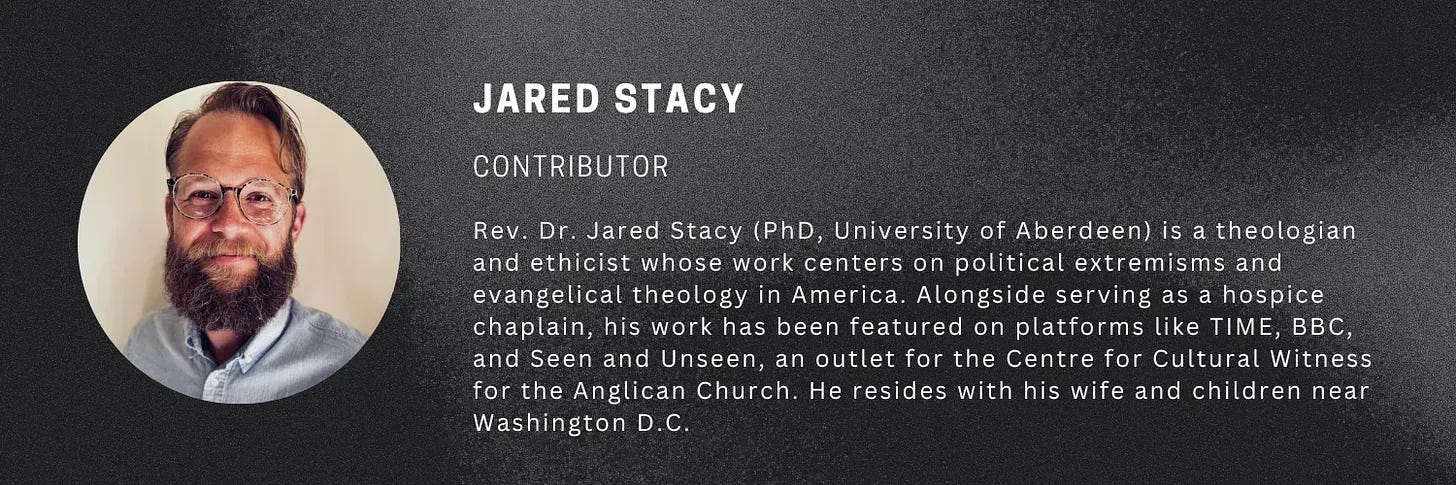
About the author: Rev. Dr. Jared Stacy (PhD, University of Aberdeen) is a theologian and ethicist whose work centers on political extremisms and evangelical theology in America. Alongside serving as a hospice chaplain, his work has been featured on platforms like TIME, BBC, and Seen and Unseen, an outlet for the Centre for Cultural Witness for the Anglican Church. He resides with his wife and children near Washington, D.C.
In these days, there is a great urge to do something. It springs from many places: a concern for human life, the constant stream of news, and also from beneath the barrage of propaganda produced by a state Christianity.
This Christianity announces revival, a renewed nation.
Mark Driscoll, the evangelical megachurch pastor ousted from Mars Hill Church last decade, signifies the renewed influence and power of this State Christianity. His comments on the Charlie Kirk funeral lay this bare:
God is bypassing the pulpit because the Gospel is not being preached with courage and faith. Instead, He is using politicians in the wake of the Charlie Kirk assassination to spread His word.
This echoes with the very error preserved and contended with in Barth’s pamphlet Theologische Existenz heute!, where—in the Spring of 1933—the ‘Three Man College’ announced to German Christians:
A powerful national movement has gripped and uplifted our German nation. In the awakened German nation a drastic reorganization of the Reich is proceeding apace. To this turning point in history we say a grateful Yes. God has granted us this. To Him by the glory! Bound together in God’s Word, we see in the great events of our days a new task laid by our Lord upon his Church . . .
Countering, Barth asks,
Who authorized them [German Christians] not only to bind the Church to a specific phenomenon of world history in this irresponsible way but also and above all, to inaugurate the proposed renewal of the Church by the proclamation of a quite novel principle of knowledge and judgement?1
In the midst of this error, Americans and Christians are endlessly confronted with the tyranny of evil, and—ironically—the tyranny of the normal, that life continues in the midst of all the convulsions.
As citizens, we know the psychological strain that lives and rages in the chasm between chaos and our commutes. The juxtaposition between scrolling through brutal videos of ICE abductions and streaming Netflix is its own sort of angst.
In this tyranny of the normal, the everyday normalizes apathy, numbing us to responsibility and solidarity. On the other end, we risk driving ourselves to despair and cynicism. Where is the church, where is the Christian life, in a time seemingly hemmed in by nihilistic despair and a dulling hedonism?
We might recognize the urge to act is not entirely misplaced. But it can be misshapen. Barth recognized this in his response in 1933 to German Christians, where he advocated for a theological existence:
…surely our primary need today is a spiritual centre of resistance which along could give church political resistance meaning and substance. Anyone who understands that will mark down on his agenda today—not some struggle or other but—the very simple reminder: pray and work!2
Counter to this work, has the church not always faced that temptation to self-justification and self-preservation? To “resort to stratagems” that reinforce the Word, as Eric Trump bragged that MAGA is “saving God”—rather than let God conquer us?
The God of Jesus needs no deliverance in the midst of history. MAGA Christians must hear the good news that the Messiah has already come.
This proclamation must arise, as is Barth’s point, from within the church that hears. For the church to be the church, the impulsive urge to do must be determined by a willingness to hear. Where the Word gains a hearing, there action becomes not only clear but concrete—given its form and content by God’s command. This is Barth’s insistent point again in §38 of his Church Dogmatics II.2:
Faith and obedience begin as we hear, as we recognize what is spoken to us. And ungodliness begins with our not hearing, and our lack of vision.3
A Christianity that has stopped its ears, that knows the gospel as content but not living communion, persists in the construction of totality. In this sense, MAGA as a totality can see or offer no other way of being Christian. In place of the Christian life and its revelation which both unveils and upends our certainties, totality offers enclosure, it collapses state into church, history into a cause, the leader as a rogue word.
By assuming the church already heard, already confessed, that the hearing of the Word is once and for all settled, the church settles for something less than the Christian life which sustains it. It becomes an agent of totality, baptizing the church into the state. This false baptism lengthens the shadow of authoritarianism, sanctioning material violence as part and parcel of “Christian ethics.”
Barth’s reflections on theological ethics are salient in a time of totality. Against the totalizing state and its willing Christian system, Barth insists over and again: the knowledge of good and evil is not the church’s to claim or to wield. The decision of good and evil has been made in Christ, all that remains, in Barth’s project, is God’s command—and obedience or disobedience.
This distinction matters in the material, in the bodies of those targeted as undocumented or undesirable. For a Christianity which constructs its own totalizing “Christian moral order” crucifies Christ again in the bodies of the marginalized; it fails to hear the living Word that speaks from outside the city.
The subversion of totality, of enclosure by systems, is this revelation of Jesus Christ crucified. The risen and living Word, who separates bone from marrow and delivers us through the division of the waters, separates human existence from our idolatrous determinancies.
We must recognize how the God of Jesus Christ delivers us from our Christianity.
Revelation loosens our grip on raw Christian content like Jesus’ disarming of Peter. This ceaseless interruption of the triune God into human existence delivers us from the determinancies imposed on us by the theological ideologies that mark MAGA Christianity in our time.
Against this Christianity, delivered from mere Christian content, the Spirit baptizes us into Christian communion, into life. As M. Shawn Copeland observes, “eucharistic solidarity orients us to the cross of the lynched Jesus of Nazareth, where we grasp the enormity of suffering, affliction, and oppression as well as apprehend our complicity in the suffering, affliction, and oppression of others.”4
The urge to do (something many feel in times of tyranny and disreality) must be disciplined by a confrontation with the command of God. This alone ensures the church does not devolve into activisms but gives a witness to the Christian life as it takes its place and participates in the common life of the world.
Karl Barth, Theologische Existenz heute!, trans. David Lewis, transcription and edition by Philip G. Ziegler, Aberdeen University Special Collections, MS 3478/2/2, 24–25.
Karl Barth, Theologische Existenz Heute!, 24–25.
Karl Barth, Church Dogmatics II.2, edited by Geoffrey William Bromiley, Thomas F. Torrance, and Frank McCombie (T&T Clark, 1957), 670.
M. Shawn Copeland, Enfleshing Freedom: Body, Race, and Being, 2nd ed. (Fortress Press, 2023), 128.
Thank you, Jared, for a very fine piece - an eloquent and profound recall to our proper place, blessed and informed/reformed under, and in witness to, God's gracious and life-giving commandment.
Oh and..."eucharistic solidarity." That slays me. Where has that term been my entire life?
This is my own attempt at this sacred act: https://ericksierra.substack.com/p/my-city-has-become-an-occupied-terror